Choosing a rehab centre may not be an easy call, more so in a place like Uttarakhand where the centres are scattered across hill and plain areas, with vastly different degrees of access. The centre you choose will greatly influence your success. Here are some of the important considerations to make before you choose. How to Choose the Best Rehab in Uttarakhand
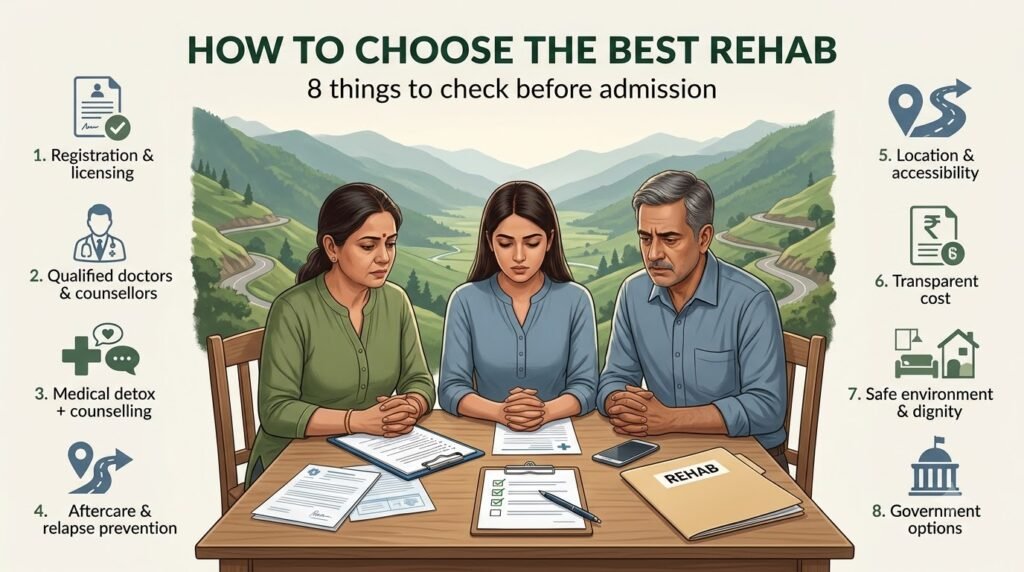
1. Licensing and Accreditation A proper rehab centre will be registered under the Mental Healthcare Act 2017, or at least have state government health department or Ministry of Social Justice and Empowerment’s de-addiction programme registration. Verify their registration before admission. Non-registered clinics do not have trained staff and proper medical monitoring which can be risky while going through withdrawal.
2. Qualified Medical and Counselling Staff Detoxification will often present with a major withdrawal syndrome (alcohol and opioids), but should only be undertaken by a doctor or psychiatrist, not untrained staff. Inquire about who manages the medical component of treatment, and whether the counsellors have training in evidence based techniques such as cognitive behavioural therapy or motivational interviewing.
3. Treatment Approach An effective programme will take care of the physical and mental aspects of addiction. Such a programme will have a medical detox, individual and group therapy and family work, not only cruel punishments and isolating methods. Uttarakhand centres with yoga and meditation focus on the regulation of emotions in addition to medical treatment; however, these are not substitutes for medical care.
4. Aftercare and Relapse Prevention: Discharge is not the end of recovery. Whether they have it in-house or find it somewhere else, check if the centre provides follow-up services, relapse prevention planning or assistance with finding support groups in the area. Centres that do not have any aftercare often see higher relapse rates.
5. Location and Accessibility: Is the centre located within reach of family visits? In hill districts of Uttarakhand like Almora, Pithoragarh or Ranikhet, distances and hilly terrain can make visits by families difficult. See if the centre is reasonably accessible for family visits, or whether it has mechanisms for involving families remotely.
6. Transparency About Cost: Fees can be much higher for a private centre than for a government unit. A good centre will be upfront about the fee and what it covers. Will the fee cover medical assessment, medication, therapy sessions, aftercare, and so on?
7. Environment and Patient Dignity: Visit if you can or at least ask plenty of questions about the daily routine, accommodation and treatment of the patients. It is important to have a centre that is not afraid of questions and be able to view accommodation where the loved one will be.
8. Government Options: Moreover, some government district hospitals of Uttarakhand also have de-addiction units, which would be relatively cost-effective than private rehabs, especially for someone living in the remote regions. They can be contacted through the District Chief Medical Officer or state health department. Conclusion: Not all rehabs are created equal — when it comes to choosing a quality rehab, size, location, and price are less important than licensing, treatment standards, effective staff, and support post-rehab. It pays to be thorough before you’re admitted.