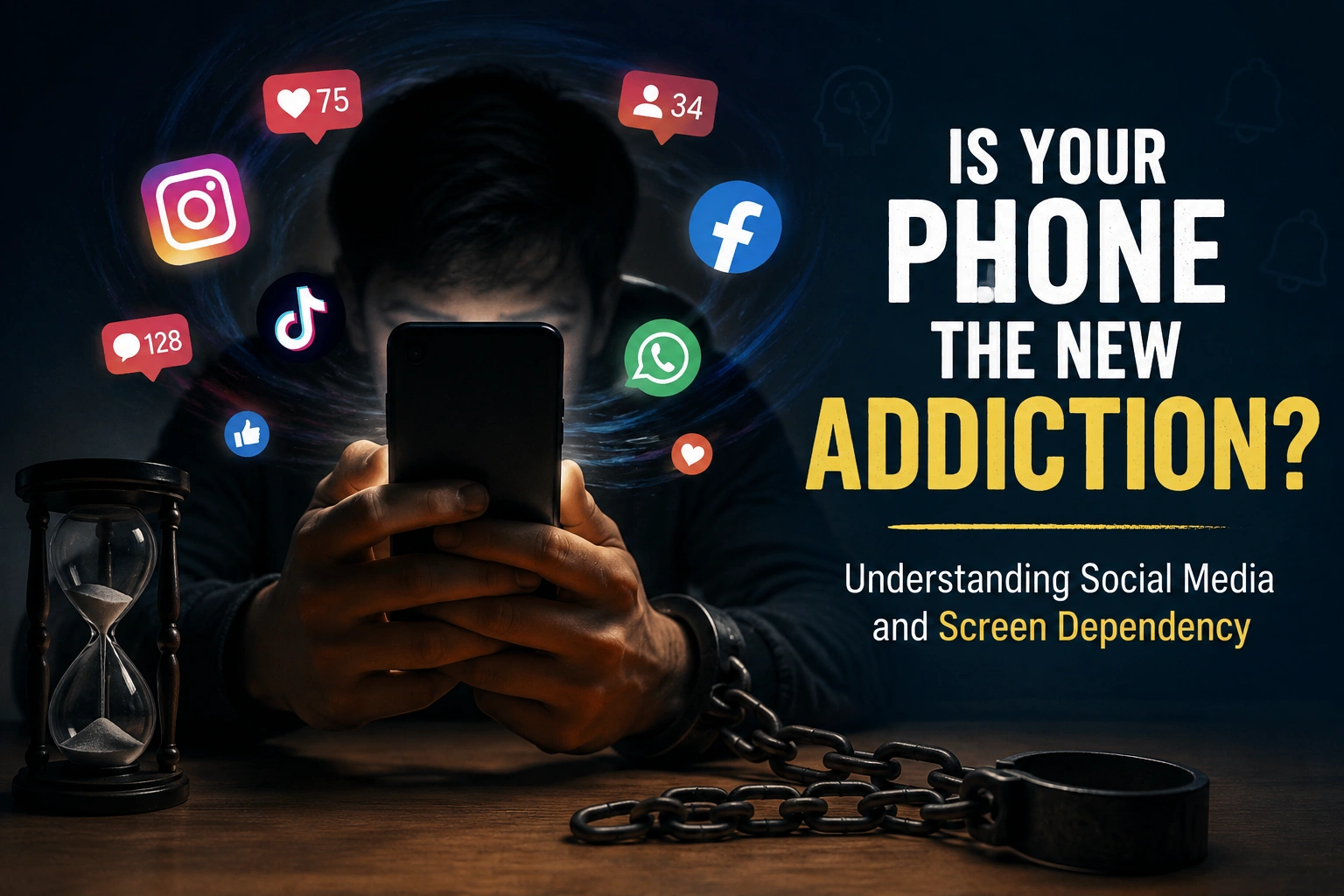
Is Your Phone the New Addiction? Understanding Social Media and Screen Dependency
When we think of addiction, substances like alcohol or drugs usually come to mind first. But addiction, at its core, is about compulsive behavior driven by the brain’s reward system — and by that definition, social media and phone use can absolutely qualify. Increasingly, mental health professionals are treating digital addiction with the same seriousness as substance dependency, because the underlying mechanism is strikingly similar.
At Hamara Sankalp Nasha Mukti Kendra in Haldwani, serving families across the Kumaon region — Almora, Ranikhet, and Pithoragarh included — we’re seeing a growing number of concerns that don’t involve a single substance, but instead center around compulsive phone and social media use, especially among young people.
How Phone Addiction Mimics Substance Addiction
Every time you get a notification, a like, or a new video on your feed, your brain releases a small hit of dopamine — the same chemical involved in substance-based reward loops. Apps are deliberately designed with infinite scroll, autoplay, and unpredictable rewards to keep this cycle going as long as possible.
Over time, this creates:
- Tolerance — needing more screen time to get the same sense of satisfaction
- Withdrawal-like symptoms — irritability, restlessness, or anxiety when separated from the phone
- Loss of control — repeatedly trying to cut back and failing
- Compulsive checking, even during work, meals, or conversations with family
This is why many experts now describe excessive social media and phone use through the same “nasha” (addiction) framework used for substances — the behavior pattern is remarkably similar, even though the object of dependency is different.
Why This Matters Right Now
Phone addiction has become one of the most commonly searched wellness concerns today, and for good reason:
- Average screen time among young people has risen sharply over the past few years
- Sleep disruption from late-night scrolling is now extremely common
- Attention span and academic/work performance are visibly affected
- Anxiety and low mood linked to social comparison on platforms is well documented
- Parents across India, including in smaller cities and hill regions, are increasingly worried about their children’s phone habits
Signs of Problematic Phone or Social Media Use
- Checking the phone first thing in the morning and last thing at night
- Feeling anxious or irritated when the phone isn’t accessible
- Losing track of time while scrolling — minutes turning into hours
- Neglecting responsibilities, sleep, or in-person relationships
- Repeated unsuccessful attempts to reduce screen time
- Using the phone to escape boredom, stress, or difficult emotions
If several of these sound familiar — for you or a family member — it may be worth treating it as seriously as any other dependency.
Why Willpower Alone Rarely Works
Just like with substance addiction, simply “trying harder” to use the phone less often fails, because the compulsion is rooted in brain chemistry, not just habit or discipline. Apps are engineered by teams of behavioral scientists specifically to be hard to put down. Expecting pure willpower to overcome that design is unrealistic for most people.
Sustainable change usually requires:
- Structured digital detox routines, not sudden, unsustainable bans
- Identifying underlying triggers — boredom, loneliness, anxiety, or stress that the phone is being used to escape
- Replacement activities that provide genuine reward — physical activity, hobbies, social interaction, yoga, or meditation
- Family involvement, especially for younger users, to create supportive household habits rather than conflict
- Professional guidance when digital dependency is affecting sleep, relationships, mental health, or daily functioning
The Family Angle
Phone addiction rarely affects just one person — it reshapes entire households. Family meals interrupted by scrolling, conversations replaced by screens, and children mirroring parents’ own phone habits are all common patterns. Addressing it usually works best as a family effort rather than singling out one member as “the problem.”
A Growing Concern in the Kumaon Region
While digital addiction is often thought of as an urban, big-city issue, smartphone penetration has grown just as fast in smaller towns and hill regions like Haldwani, Almora, and Ranikhet. Families here are noticing the same patterns — children glued to screens, disrupted sleep, and reduced face-to-face interaction — and increasingly looking for guidance on how to address it.
Getting Help
If phone or social media use has started to feel less like a choice and more like a compulsion — for you or someone in your family — support is available. At Hamara Sankalp Nasha Mukti Kendra in Haldwani, we take a whole-person approach to dependency, whether it involves a substance or a behavior, for families across Haldwani, Almora, Ranikhet, Pithoragarh, and the broader Kumaon region.
Recovery isn’t about eliminating technology from your life. It’s about restoring the balance and control that compulsive use takes away.